The Kraus Family's Apartment
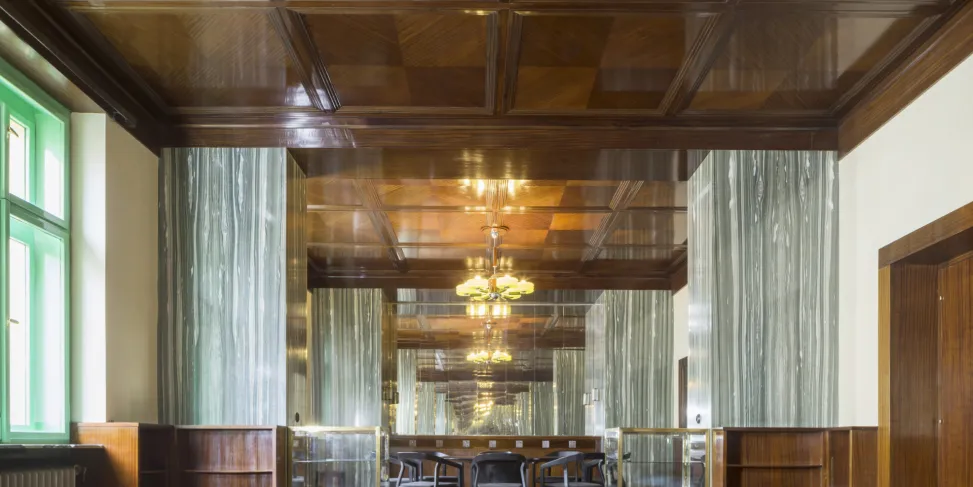
One of the most beautiful apartments in Pilsen, designed by Adolf Loos, has been preserved on the first floor of the apartment building at 10 Bendova Street. The interior was created for chemical engineer Vilém Kraus and his wife Gertruda between 1930 and 1931.
The history of the apartment and its residents is very sad and dramatic. Only Vilém Kraus survived World War II and Nazi persecution, while his wife and two children perished in a concentration camp. The apartment was subsequently confiscated by the communist regime, and Kraus was forced to flee once again, this time into exile in Great Britain. During the socialist era, the original apartment was divided into three residential units, and part of the furnishings was irretrievably destroyed.
The most valuable part of the apartment is the exclusive living room connected to the dining room. The main motif here is reflection—opposite mirrored walls create the effect of a space multiplied to infinity. Here, Loos sensitively combined green Cipollino marble with white veining, dark brown mahogany built-in furniture, and a coffered ceiling. At the center of the room stands a fireplace made of exposed brickwork, characteristic of Loos’s style.
Also of great value is the nearly completely preserved bedroom with built-in furniture set into the perimeter walls. Practical design details have also been preserved, such as the dressing table, hat racks, drawers, and well-thought-out storage spaces.
Today, the apartment is owned by the city of Pilsen. In 2014, it underwent renovation based on a design by architects Ludvík Grym and Jan Sapák. The preserved furnishings were carefully restored, while missing pieces were not replaced with replicas but complemented with contemporary designs. At first glance, it is thus clear what is original and what is new. The result is versatile spaces that also serve as venues for intimate cultural events.


