The Hammer Mill in Dobřív
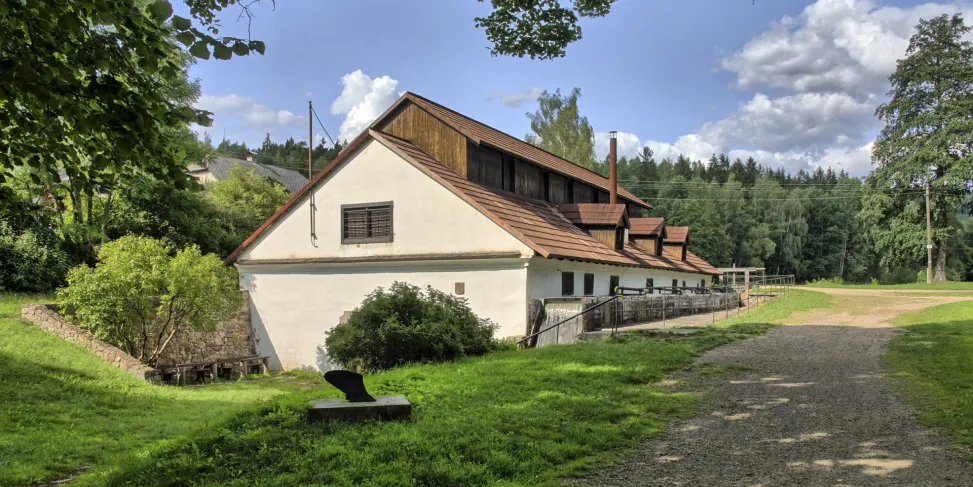
Horní Hamr—the largest and most significant historic site of its kind in the Czech Republic—hosts a very interesting and popular exhibition. Are you curious about how iron was processed and how Horní Hamr became the leading iron producer in the Czech lands? Then come take a look.
Iron processing has a rich history in Dobřív—iron was produced and processed here from the early 16th century until the mid-20th century. Until the mid-19th century, the Podbrdsko region was even the leading producer of iron in the Czech lands.
Today’s brick building, dating from the early 19th century, stands on the site of old wooden ironworks from 1658 and 1701. The extensive machinery dates from the 19th century, specifically 1901, and partly from later periods. Originally, the forge smelted raw iron from a blast furnace and used it to forge bar-shaped semi-finished products. With the spread of more modern steelmaking technology, the hammer mill switched to the production of heavy forged tools in the late 1860s. Up to 28 workers were employed there until 1949.
The sprawling hammer mill building, with its skylight, is set into the ground on one side and, on the other, rests beneath the trusses of a water tower equipped with four water wheels. Two of these waterwheels drive heavy overhead hammers, while the others, via a ceiling-mounted belt drive, power a light tail hammer and a pair of mechanical shears. Visitors can also see other tools and equipment inside the hammer mill. The hammer mill is connected to a historic water distribution system that channels water power from the Černý Stream to the individual metallurgical facilities.