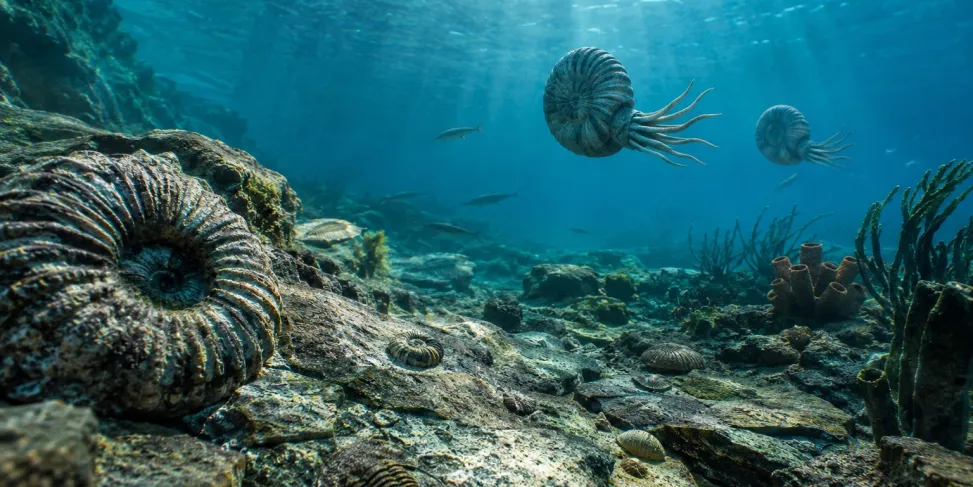
A Journey Along the Bottom of Prehistoric Seas
Joachim Barrande would be delighted. The area that bears his name—which he explored and made famous around the world—has become a national geopark. It is the largest national geopark in the Czech Republic, covering an area of 4,316 square kilometers. It spans parts of the Central Bohemian and Pilsen regions and the City of Prague.
It features world-renowned sites from the early Paleozoic era, the most significant of which is the Silurian–Devonian boundary at Klonek near Suchomasty. Barrandien reveals the secrets of millions of years of Earth’s evolution. The geopark is a colorful mosaic of geological and paleontological attractions. The geological profiles and outcrops are not as massive as those found elsewhere in the world, but they are remarkably diverse and easily accessible by bike, on foot, by boat, by train, or even by tram.
The geopark is not just a fossilized past. It holds stories of Czech history, industrial development, and the settlement of the region. Barrandien is a jewel of Czech geology and paleontology. The Orlov Ecological Center’s efforts over several years were instrumental in securing the status of a national geopark. The geopark’s partners include the municipalities of Jince, Tetín, Strašice, Mirošov, and Radnice. The establishment of the national geopark is also important for the development of tourism. It will offer visitors and local residents a comprehensive insight into geology and paleontology, as well as zoological, botanical, archaeological, cultural, and historical contexts.